Google CPG blog - News and Notes from Google"s CPG Vertical

Moms Know Tech Update

Thursday, April 19, 2007


We've had such a great response to our Mom's Know Tech event in Chicago next week that we're full to capacity. We'll be sure to post some highlights following the event, and we're considering holding similar events at other Google offices in the near future. Thanks for your interest, and stay tuned!


The Perfect Egg

Monday, April 16, 2007


Call it a slow news day or post-Easter chocolate detox...either way we, the Google CPG team, LOVE Cadbury Eggs. So, we find this clip on YouTube from Conan O'Brien to be funny and somehow relatable - perhaps it hits a little close to home in revealing one guy's idiosyncratic tendencies.


And I thought I was alone in stashing Cadbury Eggs for the coming months, pulling out my little blue bags of chocolate gold in times of need, hunger, or just when I felt deserving of a treat. The weird thing is I'm not that way around other holidays. I don't hoard Halloween or Christmas treats. Valentine's Day candy does nothing for me. But, those mini eggs are something I eagerly anticipate every year. I know they hit the stores in time for Valentines Day and will be gone before Easter Sunday. As I said, after viewing the Conan clip on YouTube, I now know that I'm not alone. Take a look at just some of the Egg lovers here on the Cadbury Egg Goo-off contest.

Cadbury and Hershey's (Hershey's holds a license to make Cadbury chocolate for the US) face an interesting dilemma. Certainly the demand is there for these seasonal Eggs to be available year round. But do they lose their unique marketing appeal and cachet by going year round? Hard as it is for me to say, these things mean spring and Easter as much to me as daffodils, daylight savings and the start of Little League. Keep it seasonal, Cadbury Eggs, I count the days until you return.

Moms Know Tech

Monday, April 16, 2007


Understanding how moms communicate and interact with media on a daily basis is an intregal part of marketing to this powerful demographic. According to eMarketer, 32.2 million moms are online in the U.S -- or 18.4% as a total percent of U.S. Internet users. We feel this group of tech savvy women is so important that Google's CPG vertical is holding a Moms Know Tech event in Chicago on April 24th.

The 3-hour seminar will include presentations by industry experts who will help us learn more about this segment of online users and the implications of their online habits for your brand. There will also be a panel of moms discussing their media habits, priorities, and technology attitudes and behaviors.

If you'd like to attend or learn more, please contact your account executive or account manager.

Product Recalls: Informing and Educating at a Crucial Time

Thursday, April 12, 2007


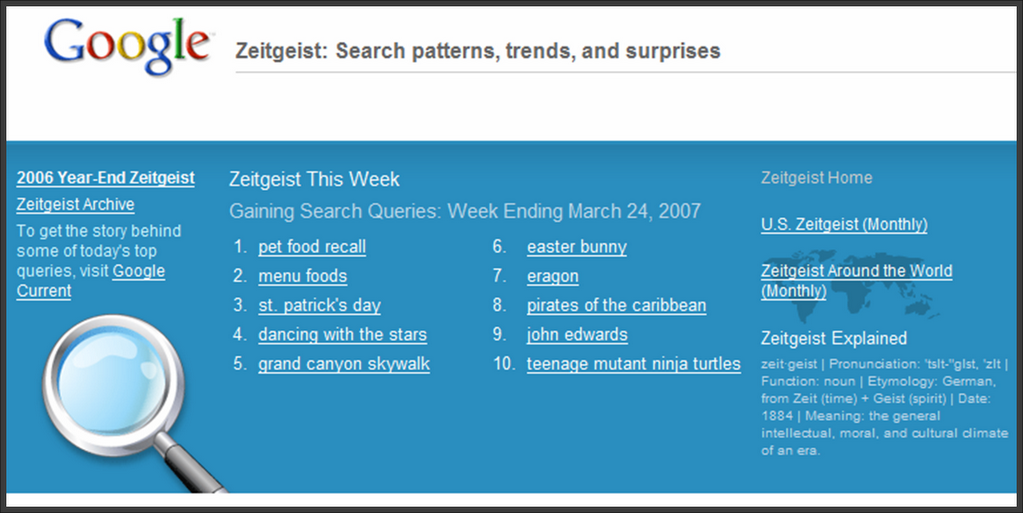
When we published the weekly Google Zeitgeist for March 18-24, it was the first time in 6 years that a product recall has placed in the #1 and #2 positions in our top gaining searches. Clearly the pet food recall has sparked a tremendous interest in finding information online through search, more so than any other recall seen to date:


We have learned some valuable lessons as a result of the many recent recalls. Here are a few of our top findings:

1. Breaking news fuels online searches

This surge in online activity around the pet food recall is not surprising. Those working with brands affected by the many news events of 2006 have learned that there is an immediate, measurable online reaction to product recalls and negative press. The recent peanut butter e.coli scare and computer battery recalls are just a few of the recent events that catapulted affected brands into our top search queries.

2. Breaking news fuels growth of online content

The conversation spreads rapidly online as news stories, editorials, blog posts, online comments, and even consumer-generated videos are quickly added to the web after the story breaks. In the wake of the spinach e.coli outbreak in fall 2006, many forms of content was added to the web, and today there are more than 1.98 million indexed pages and 6,750 blog posts that referenced the recall.


3. Nimble companies, or competing interests, are often the first to react

Other interested parties often act quickly to get their messages out as soon as the news breaks. Once the peanut butter recall story broke, lawyers immediately targeted related searches and created websites to provide information that would help consumers identify whether they had been affected in order to consider taking legal action. Ads for lawyers and consumer groups still make up the majority of search and content ad messages that are targeting consumers searching for recall related information online.

Because our data reveals that consumers begin searching online immediately after the news of a recall is released, it is extremely important that companies prepare for this influx of searches by considering the following three steps:

1. The moment information is publicly available, make it findable.

Pet food recall searches were some of the top gaining searches on Google the week the story broke, it is clear that concerned consumers are in record numbers using search engines to find recall information. Ensure the official information is available by immediately routing searches to the press release and official statements the moment it is available online.

2. Target Searches and Content in Post-Event Proactive Branding Campaigns:

The spotlight of press and public concern can cause immediate spikes in active searches for brand information, but it's important to have a continuous presence on search and content targeting in the months that follow.

3. Use Site, Sound and Motion for Maximum Impact:

When jetBlue passengers were stranded on the tarmac at JFK, frustrated customers who were stranded at terminals decided to post their own video accounts on YouTube. jetBlue’s founder, David Neeleman, responded by posting an apology on YouTube, which quickly became one of the top ten most viewed videos of the week. His apology received more than 85,000 views in 48 hours, and has had 276,000 total views to date. YouTube and video ads can act as a powerful additional broadcast outlet – marketers should consider make official statements, interviews, and important information available in video format.